 Analysis byWeUseApps
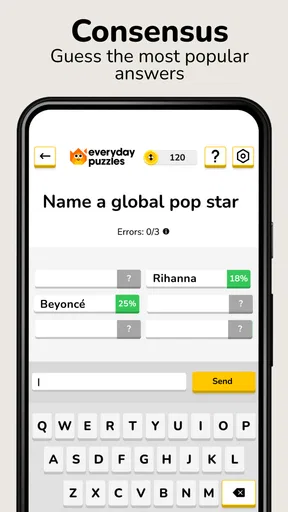
I like a puzzle game best when it gives me something to think about without turning every spare minute into homework. Everyday Puzzles: Mini Games aims for exactly that kind of casual appeal: it brings several familiar word-game formats together in one app, including Hashtag, Crossword, and Word Search. The result is a trivia-minded collection that feels easy to dip into, whether I’m after a quick mental warm-up or a quieter stretch of wordplay.
Everyday Puzzles: Mini Games is a free game from Fanatee, Inc., and its straightforward premise does much of the work. Rather than centering the experience on one long campaign, it puts everyday puzzles front and center. That makes it approachable for players who enjoy language challenges but want variety, and for anyone who would rather choose a puzzle by mood than commit to a single style for the whole session.
A welcoming first impression
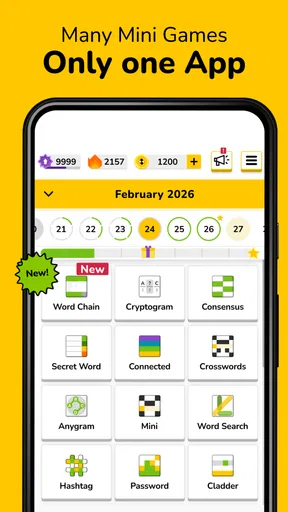
The app’s strongest first impression is its clear focus. “Many Word Games in 1 App” is a concise promise, and the selection named in its description gives that promise shape: hashtag puzzles, crosswords, and word searches. Those formats are easy to recognize, so I can understand the basic appeal before I even decide which one suits me. It’s a low-friction pitch for a word puzzle game that doesn’t ask me to learn a complicated premise first.
That familiarity also makes the game easy to recommend to different kinds of puzzle fans. A crossword lover knows what sort of challenge to expect from that format; a word-search fan can gravitate toward scanning for words; and Hashtag offers another flavor of language play. The appeal isn’t that these formats are mysterious or radically unfamiliar. It’s that they sit together under one roof, giving the app a broader everyday role than a single-mode puzzle game.
The game has attracted a substantial audience, with more than 10 million installs and an average rating of 4.6 from around 95,000 ratings. Those figures suggest that the basic idea has found plenty of people looking for accessible word games. They don’t determine whether every puzzle will suit every player, of course, but they do place the app among established choices for casual trivia and word games.
Its release date is January 19, 2022, and the current version is 13.8.0. The listed minimum operating-system requirement is version 7.0, while the content rating is Everyone. For me, those details fit the broad, all-ages tone suggested by familiar word puzzles: the central appeal is language and deduction, rather than a specialized setting that demands a particular background.
Three familiar puzzle identities
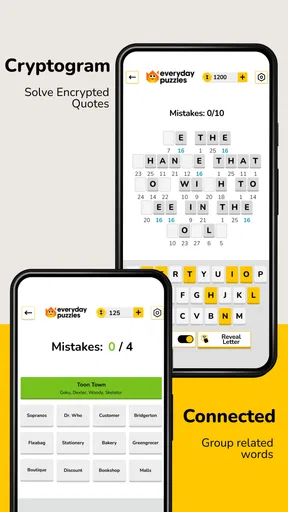
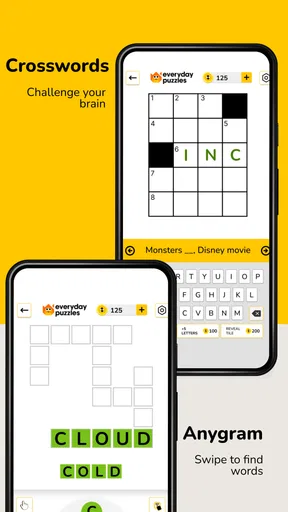
The named modes give the collection its personality. Crosswords call on clues and word knowledge, while word searches emphasize recognition and patience. Hashtag puzzles add a distinct label to the mix, helping the app avoid feeling like a bundle made up of only two variations on the same activity. These formats create different mental rhythms even though they all revolve around words.
That variety matters more than a long list of features would. A player who wants to work through clues can choose a crossword-style challenge; someone in the mood for a more visual search can choose a word search. The app’s concept is therefore easy to grasp without needing a dramatic fictional world or elaborate narrative. Its setting is the everyday puzzle session itself: a small invitation to focus on words, then move on when the moment feels right.
A visual language built around play
With its familiar formats, the game’s art direction has a practical job: help the different puzzle styles feel like parts of one collection while keeping the activity itself in view. The overall concept is tidy and accessible rather than dependent on a grand fantasy setting. That restraint suits the material. Word games are most satisfying when the presentation supports concentration instead of competing with the clues, letters, or search task.
The app’s title and short description reinforce this everyday identity. “Everyday Puzzles” suggests something approachable and repeatable, not a high-pressure contest or a sprawling adventure. I find that positioning useful because it sets a comfortable expectation: this is a place to pick up a small language challenge, enjoy the process, and return when I feel like another one. The mood comes from the ordinary pleasure of solving, not from a heavy story layered over the puzzles.
There is also an appealing contrast between consistency and variety. A collection needs enough unity to feel like one game, yet each puzzle format should retain its own character. Crosswords, Hashtag, and word searches naturally provide that contrast. Their shared focus on words ties them together, while their different approaches give me a reason to switch modes when one kind of thinking starts to feel repetitive.
That structure is a good fit for a casual game because it makes choice part of the experience. I can decide whether I want to interpret clues, look for words, or try the app’s Hashtag format, rather than having the same interaction dictate every session. The design idea is simple, but it gives the collection a coherent identity: a relaxed home for several recognizable kinds of wordplay.
Sound, pacing, and the pause between puzzles
The game’s premise lends itself to a gentle pace. These are mental challenges built around reading, noticing, and finding answers, so the natural rhythm is more measured than frantic. I can take a moment with a clue or scan a word-search grid without needing the whole experience to feel like a race. That calm quality is central to the appeal of an everyday puzzle game: the player sets the tempo by how much attention they want to give.
Sound is part of a game’s mood, but it shouldn’t distract from language-based play. Here, the formats themselves establish the important rhythm: focus on the current puzzle, make progress, and decide whether to continue or change the kind of challenge. That structure leaves room for the app to work as a small break in the day rather than demanding a long, uninterrupted session.
For players who enjoy quiet concentration, this is a useful distinction. A word puzzle does not need constant spectacle to hold attention; the satisfaction comes from seeing a clue click or spotting a word that was hiding in plain sight. The game’s collection format supports those small moments by giving me a few different routes into the same broad pleasure of solving.
I also appreciate that the app’s everyday framing doesn’t imply one correct way to play. Some sessions can be brief, while others can stretch out as I move between puzzle types. The mood is flexible: it can be a quick distraction or a more focused word-game session, depending on the time and energy I have. That flexibility is a better fit for casual play than a structure that insists every visit must become a major commitment.
How the mechanics fit together
The core mechanical idea is variety within a shared subject. Crosswords and word searches are well-established formats, and their different demands complement each other. One asks me to connect clues with answers; the other asks me to recognize words among surrounding letters. Hashtag adds another named option to round out the selection. Together, they make a more versatile package than a game built around only one kind of word challenge.
That variety is especially valuable when I’m choosing a puzzle by energy level. If I want to reason through a clue, a crossword is a natural choice. If I’d rather search visually, a word search provides a different kind of focus. This change of mental texture helps the collection avoid becoming one-note, even though all of its named modes share a language-centered foundation.
The game is categorized as trivia, which makes sense in the broad sense of exercising knowledge and word recognition, but its appeal isn’t limited to trivia enthusiasts. Anyone who likes finding patterns, thinking through clues, or playing with language can understand the draw. It is a welcoming entry point for casual players and a convenient variety pack for people who already enjoy puzzle apps.
As with many free mobile games, there are optional in-app purchases, priced from $0.99 to $49.99 per item. The game itself is free to download, so it’s easy to explore its central idea without paying an upfront price. I’d approach the optional purchases with the usual care: decide what feels worthwhile for your own play, rather than assuming spending is necessary to enjoy word puzzles.
In practical terms, the collection works best for players who value accessible formats and the freedom to change direction. It may be less compelling for someone looking specifically for a deep narrative, a complex progression system, or one highly specialized puzzle mechanic. The game’s identity is broader and more casual: several word-game styles gathered into a single everyday destination.
Who is likely to enjoy it?
I’d point this toward anyone who wants a casual word game for short breaks, especially if choosing between different puzzle formats sounds more appealing than playing the same mode every time. Crossword fans get a familiar option, word-search players have another, and the Hashtag mode gives the collection an additional identity. The range makes the app easier to revisit when my mood changes.
It also suits players who prefer a low-pressure experience. The premise is clear, the puzzle types are recognizable, and the emphasis stays on solving rather than on an elaborate fictional world. That doesn’t make the game shallow; it simply means its depth comes from the puzzles themselves and from the way different formats engage different kinds of attention.
On the other hand, players looking for action, a strong story, or a highly competitive atmosphere may find the everyday approach too modest. That is not a flaw so much as a matter of taste. The app knows its lane: approachable language play, a selection of familiar formats, and a pace that can fit into ordinary downtime.
A satisfying everyday mood
What holds the experience together is its sense of proportion. The game doesn’t need an elaborate setting to justify its collection of puzzles; it makes the act of solving the setting. The word-centered presentation, recognizable mechanics, and flexible rhythm all support the same mood: take a breath, focus on a small challenge, and enjoy the moment when the answer becomes clear.
For me, that is the most appealing part of Everyday Puzzles: Mini Games. Its modes offer enough contrast to make changing activities feel worthwhile, while the shared language theme gives the app a clear identity. It’s a straightforward proposition, but a useful one for anyone who likes crossword and word-search puzzles and wants more than one familiar format close at hand.
The game’s strong audience response and broad content rating reinforce its accessible character, while its free-to-play structure makes it easy to try. I would describe it as a relaxed collection rather than a dramatic, all-consuming game: a handy option when I want to exercise my word skills without taking on a big commitment. Its appeal comes from the small, satisfying loop of choosing a puzzle, giving it my attention, and seeing how far I can get.
If that sounds like your kind of break, Everyday Puzzles: Mini Games is worth a look. It brings Hashtag, Crossword, and Word Search together in a simple package with an easygoing pace and a clear focus on everyday play. I’d recommend it to casual puzzle fans who value variety, familiar mechanics, and a calm way to put their language skills to work.
What we like
- Quick rounds make it easy to play during short breaks.
- A varied puzzle mix helps keep daily sessions fresh.
- Simple controls make most games easy to pick up.
- Daily challenges provide a reason to return.
- Many puzzles encourage logic and attention to detail.
What could be better
- Some puzzle types may feel repetitive over time.
- Difficulty can vary noticeably between mini games.
- Frequent ads may interrupt the flow of play.
- Progress may depend on completing daily tasks.
- Small screens can make certain puzzles harder to solve.