Block Blast! Shows How Much Strategy a Simple Puzzle Needs
 Analysis byWeUseApps
The modern mobile puzzle game has a harder job than looking simple. Players want rules they can grasp in seconds, decisions that reward attention, and enough room to improve without turning a spare-minute pastime into homework. Block Blast! makes a persuasive case that the category’s next standard is not more systems, stories, or spectacle. It is a familiar loop with enough strategic tension to keep a player thinking after the first few moves.
That distinction matters because the puzzle aisle is crowded with games that add a second activity to the board: a renovation, a narrative, a collection, a sorting challenge. Those layers can make a game stickier, but they can also distract from the pleasure of solving. Block Blast! keeps its attention on placement. Its appeal, and its limitation, both come from that decision.
The puzzle baseline has moved
Players now expect a puzzle game to explain itself almost immediately. A board should be readable at a glance, a move should have a clear consequence, and failure should feel understandable rather than arbitrary. The best mobile games also respect interrupted play: a round should make sense in a short break, with no elaborate setup required before the thinking begins.
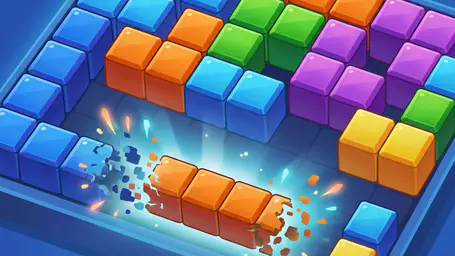
Block Blast! meets that baseline with a square grid and a small selection of blocks. Place pieces to complete rows or columns and clear them; keep making space, because the board fills up and eventually leaves no workable move. There is no need to learn a campaign map or juggle several currencies before the basic pleasure arrives. The rules are visible in the board itself.
That simplicity does not mean the game asks for no judgment. A placement can tidy one area while sealing off another. A large piece may fit now but leave an awkward pocket behind. Clearing lines creates breathing room, yet waiting for the perfect arrangement can cost valuable space. The player is constantly trading immediate relief for future flexibility, and that small pressure gives each turn its weight.
What Block Blast! signals
The strongest signal is how much the game can extract from a limited vocabulary. Blocks go onto a grid; full lines disappear; the aim is to last. From that modest toolkit comes a rhythm of scanning, testing a few placements in the mind, and committing. A good clear feels like releasing a held breath. A poor choice can be obvious only several turns later, when the board’s empty spaces stop connecting.
Readable rules can still produce meaningful decisions. That is the category lesson. A puzzle does not need a sprawling feature list to create replay value if its central choice changes with the board. Here, the same piece can be welcome in one position and disastrous in another. The changing geometry supplies much of the variety that a story or rotating objective might otherwise provide.
The pace is unusually direct. There is little ceremony between intention and result: drag a shape, watch lines clear, reassess. That makes the game well suited to brief sessions, but it also supports longer stretches because the board keeps presenting a fresh local problem. A player can stop after a few moves or stay to see whether a carefully managed board survives another run of awkward pieces.
Its appeal is not that every round becomes a grand tactical puzzle. Some stretches are generous; others feel constricted by the pieces at hand. Instead, the game makes ordinary spatial decisions feel consequential. That is a useful standard for casual design: difficulty can come from how the player manages uncertainty, not from hiding the rules.
The familiar conventions, and the one it pushes against
Block Blast! follows the genre’s most durable conventions. It is easy to begin, its board communicates state without explanation, and each action gives immediate feedback. The familiar act of clearing a line offers a compact reward, while the threat of a crowded board keeps the session from becoming entirely passive. These are proven ideas for a reason: they make a puzzle legible, tactile, and easy to return to.
Where it pushes against current fashion is in refusing to make a larger fictional project the main reason to play. Gossip Harbor: Merge & Story ties its merge puzzles to characters and ongoing narrative. That approach gives progress a broader context: a match can help move a story forward. Block Blast! makes no equivalent promise. Its progress is the board’s survival and the player’s own sense of better judgment.
That refusal is both refreshing and restrictive. Players who want a cast to follow, places to restore, or a steady stream of narrative milestones may find the board too self-contained. But the contrast shows that puzzle design has two competing forms of reward: an external track that keeps unfolding, and an internal loop that asks the player to get better at reading the next move.
What neighboring games reveal
The range of nearby puzzle concepts shows how broad the category’s baseline has become. Meowdoku: Brain Puzzle Games puts a familiar logic framework into a themed package, using presentation to give a recognizable format a distinct identity. Rotate Rings leans on spatial manipulation, making the act of turning pieces part of the central problem. Magic Sort! makes order and organization the pleasure, while Word Tiles - Relaxing Puzzle draws on language and the satisfying assembly of words.
These games do not prove that every puzzle needs a story or a novel mechanic. They show that players increasingly expect a clear identity alongside clear rules. A strong puzzle can announce its particular pleasure quickly: arrange, rotate, sort, form a word, or manage a changing grid. Block Blast! is unusually plain in its premise, so its identity depends on the quality of the placement decisions and the cadence of clearing space.
This is where comparison sharpens the point. The category is advancing less through one dominant format than through sharper promises. Some games promise narrative momentum; others promise a soothing task or a specific kind of mental workout. Block Blast! promises the pleasure of keeping a board alive. Its best moments deliver on that promise without asking the player to care about anything beyond the next arrangement.
The standard emerging from the grid
The next standard is likely to combine Block Blast!’s immediate readability with a stronger sense of personal progress. Players should be able to understand the challenge at once, but they also benefit from goals that make improvement visible: a meaningful score to beat, a satisfying session milestone, or a way to recognize a better decision-making habit. The key is that these supports should clarify the core loop rather than bury it under chores.
That balance is difficult. Add too little and a game can feel interchangeable after the novelty fades. Add too much and the board becomes a delivery system for timers, upgrades, and distractions. Block Blast! makes a useful counterexample to feature inflation: a clean loop can sustain attention. But it also highlights the risk of relying on repetition alone. The longer a player stays, the more the game needs fresh reasons to care about another attempt.
Casual puzzle games also still struggle to make difficulty feel fair over time. A tight board can be the result of a player’s earlier choices, but a run can also depend heavily on which pieces arrive and when. The challenge is to preserve uncertainty without making the player feel that skill has been sidelined. Block Blast! makes the tension easy to see, but the basic format offers limited ways to explain or soften an unlucky-feeling run.
There is a second lag: many games in the category are excellent at producing short bursts of satisfaction but less thoughtful about how those bursts fit together. A good clear is immediate; a longer arc can be hazy. Narrative-led peers solve that with story, while collection systems solve it with accumulation. A stripped-back game needs another answer, whether that is meaningful variation, transparent goals, or a more legible sense of mastery.
Why this matters to players
For players, the choice is increasingly about the kind of attention a game asks for. Block Blast! suits someone who wants to look at a board, make a decision, and see the consequence without first tending to a virtual project. Its low barrier is genuine, not a disguise for a complicated opening. The trade-off is that its rewards remain closely tied to the act of playing; there is less of a parallel world to return to between rounds.
That is not a flaw for every audience. A self-contained puzzle can be easier to fit into daily life than a game that makes every visit feel like catching up. Yet players who rely on changing objectives or character-driven progress may feel the loop narrow over time. The category’s challenge is to offer both kinds of satisfaction without pretending they are the same thing.
Block Blast! is most revealing when treated not as a contest against every story-rich or themed rival, but as a test of the grid itself. It shows that the simplest format still has room for tension, rhythm, and replay, provided each placement matters. Its limits are just as instructive: a clean mechanic can carry a game a long way, but clarity alone does not guarantee long-term variety.
The mobile puzzle game is not moving toward maximum complexity. It is moving toward better-defined pleasures. Block Blast! makes the case for a board that explains itself and a loop that trusts the player to care about making the next move well. The category’s strongest future will keep that honesty, then add variety and progress only where they deepen the puzzle. More decoration is easy; a reason to think one turn further is the harder achievement.