 Analysis byWeUseApps
I judge a ring-rotation puzzle by a simple test: does solving it feel satisfying, or does it turn into fiddly trial and error? Rotate Rings leans toward a calm, bite-sized kind of logic challenge. I’d consider it when I want to focus on one small problem during a break, rather than commit to a long campaign or compete for a score.
How the puzzle feels in everyday play
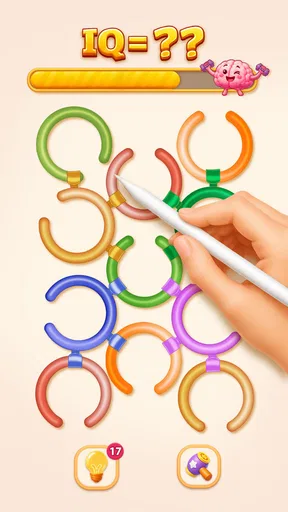
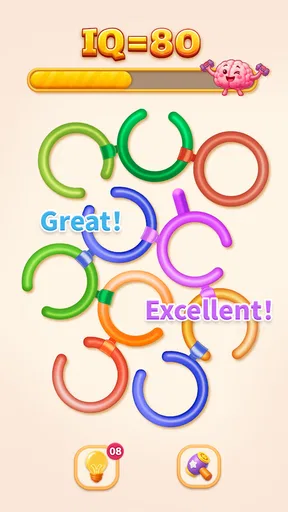
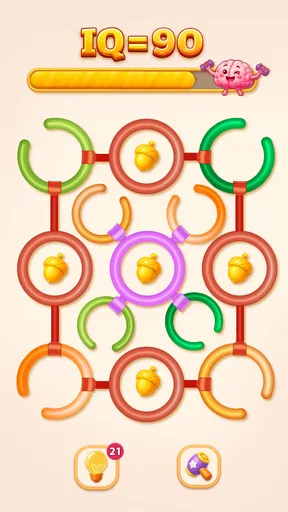
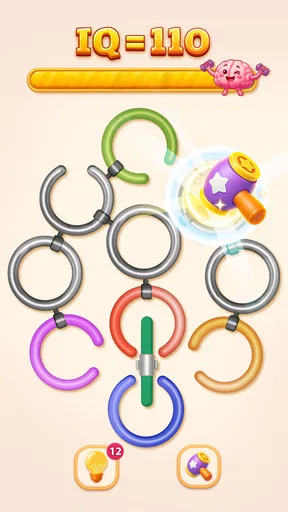
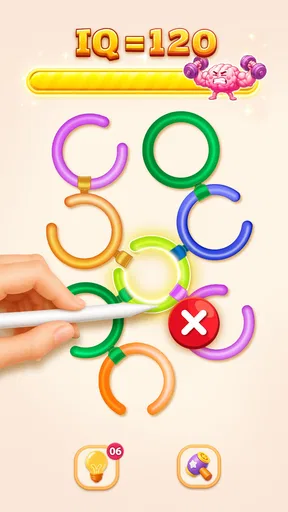
The basic idea is easy to grasp: turn rings and work toward a satisfying arrangement. That simplicity is the game’s main appeal. There is little to learn before you can start thinking about the puzzle itself, so it suits a short pause between tasks as well as a longer, quieter session.
In my view, the key question is whether you enjoy reasoning about how a local move affects the larger pattern. Rotating one ring can change what appears aligned elsewhere, which encourages you to look beyond the most obvious immediate fix. The pleasure comes from gradually understanding the relationships, not from tapping quickly.
That makes this a better fit for people who like visual logic than for anyone looking for a story, a sprawling set of modes, or action-game intensity. The store summary describes offline brain training, and the game’s central premise naturally suits play without needing a live opponent. I’d still treat it as a relaxing puzzle rather than a formal training program: it gives your attention something to work on, but that is different from promising measurable cognitive results.
A useful way to approach each arrangement
When a ring puzzle looks tangled, I find it helpful to pause before turning anything and identify the parts that already look settled. Then I’d choose one visible mismatch and ask which ring can affect it without undoing too much elsewhere. This deliberate approach is more useful than spinning several rings at random, especially if the first move makes the picture look worse before it gets better.
Another practical habit is to think in terms of reversible experiments. Make one move, inspect what changed, and use that result to refine your mental model. If you lose track, reset your attention rather than trying to remember a long sequence of speculative turns. That kind of step-by-step reasoning is where a compact ring puzzle can feel rewarding instead of frustrating.
For an ordinary daily scenario, I can picture opening it while waiting for a coffee or sitting through a short commute. A single puzzle gives that idle time a little structure, while the low-pressure premise makes it easier to stop when the moment ends. If you tend to start mobile games and then feel obliged to keep playing, this style is less demanding in spirit than a game built around a continuing competitive session.
Where it sits among puzzle games
Compared with word puzzles, Rotate Rings asks less of your vocabulary and more of your spatial attention. Compared with number-grid logic games, it trades written deductions for visual relationships between rotating parts. That distinction matters: someone who enjoys spotting patterns but tires of filling cells or forming words may find the ring format refreshing.
It is not automatically better than those alternatives. A number puzzle can make each deduction explicit, and a word game may offer a clearer sense of progress if you like testing knowledge. Rotate Rings is at its strongest when the visual arrangement itself is the appeal. If you dislike mentally tracking how one adjustment influences another, the same mechanic may feel repetitive or opaque.
The category is puzzle, and Nebula Studio is the developer. It has an average rating of 4.8 from around 262,000 ratings, with about 2,300 written reviews and over 10 million installs. Those figures suggest that the straightforward concept has found a substantial audience, but they cannot tell you whether its particular style of visual reasoning will click for you. I would use them as context, not as a substitute for matching the game to your taste.
What the current release tells players
The current version is 1.1.6, while the listed release date is July 31, 2026. Those facts tell me which release information is current; on their own, they do not establish what changed between versions. I would not read a version number as proof of new puzzle types, a redesigned interface, or a particular improvement. For an existing player, the reliable takeaway is simply that 1.1.6 is the version identified for the current offering.
That distinction is useful when deciding whether to return. If you already enjoy the ring mechanic, the current version is the sensible point of reference when you check the app store for an update. If you stopped playing because you wanted a fundamentally different kind of challenge, the version number alone is no reason to expect that the game has changed direction.
For a new player, the release information is less important than the basic fit: do you like calm, visual problem-solving, and are you comfortable working out how rotations interact? The game is free to download, with optional in-app purchases priced from $0.99 to $9.99 per item. That makes it possible to approach the core experience without an upfront purchase, while still leaving room for paid items. I’d check what any purchase offers before spending, rather than assuming that paying is necessary to enjoy the central puzzle idea.
The content rating is Everyone, and the minimum operating-system requirement is Android 7.1. Those details help with basic suitability and device compatibility. They do not change the central recommendation: the game is most appealing to people who want a gentle logic activity, not a broad entertainment package with many different kinds of play.
What returning players should keep in mind
If you have played before, it is worth judging the game on the puzzle-solving loop you actually enjoy, rather than expecting a version update to address every possible source of friction. A ring-based challenge can be relaxing precisely because it stays focused; that same focus means it may not satisfy someone who wants a constant stream of new mechanics. Existing fans who like returning to a familiar style of reasoning have a clearer reason to continue than players waiting for a major change that has not been established.
I also recommend setting your own stopping point. A puzzle that remains unsolved can tempt you into repeated, unplanned moves, which often makes the pattern harder to read. Take a brief pause, then return and inspect the arrangement with fresh eyes. This is a small but useful workflow for a game that asks you to notice relationships rather than react quickly.
The trade-offs before you install
The strongest limitation is also the defining constraint: the experience revolves around rotating rings. If that mechanic does not hold your interest, a large audience or a high average rating will not make it feel varied. Players who want a narrative, a competitive ladder, or several clearly different puzzle formats should look at another kind of game instead.
There is also a difference between calm and effortless. A relaxing presentation does not mean every arrangement will be obvious. Some players may enjoy the moment when a pattern finally makes sense; others may dislike having to infer the consequences of each move. If you prefer puzzles that explain each deduction step or guide you toward a single clear route, a more structured logic game may suit you better.
Offline play is part of the game’s stated appeal, which makes it a reasonable candidate for places where connectivity is inconvenient. I would still distinguish that from other practical questions: offline suitability does not itself tell you how much storage the game uses, how its purchases work in detail, or what every device-specific behavior will be. For a straightforward decision, the important point is that the central attraction is a self-contained logic activity rather than a live multiplayer match.
Who I would recommend it to
I’d recommend Rotate Rings to someone who likes quiet visual puzzles, wants something easy to pick up for a few minutes, and finds satisfaction in testing a move and learning from the result. It may also suit a person who has grown tired of word or number puzzles and wants a different way to exercise pattern recognition without moving into a fast-paced game.
I would steer away from it if you need frequent mechanical changes, a strong narrative reason to keep going, or a clear competitive goal. I’d also suggest trying a different puzzle style if rotating pieces feels like guesswork to you rather than a solvable system. The best match is not simply “anyone who likes puzzles”; it is someone who enjoys spatial relationships and is happy to think through small adjustments.
My final take
Rotate Rings is a focused puzzle game whose appeal depends on whether its central visual mechanic suits your mind. I like the idea of having a calm problem to work through in spare moments, and its offline-oriented framing makes that use case especially natural. At the same time, I would not mistake a simple premise for guaranteed variety: the repeated ring-rotation approach is exactly what some players will want and what others will eventually tire of.
For someone curious, the free entry point makes it reasonable to try before deciding whether optional purchases are worthwhile. I’d approach it patiently, use deliberate single-move experiments, and stop when the puzzle stops feeling enjoyable. The current version gives existing players a clear reference point, but I would wait for concrete release details before expecting any particular change. If you want calm spatial logic, this is an appealing option; if you want a broad or constantly evolving puzzle collection, another game is likely a better fit.
What we like
- Simple controls make the game easy to pick up.
- Short rounds suit quick play sessions.
- Ring rotation creates a clear puzzle challenge.
- The rules are easy to understand without a tutorial.
- It can be played without a constant internet connection.
What could be better
- Later levels may feel repetitive.
- Precision can be difficult on smaller screens.
- The minimalist presentation may lack visual variety.
- Progress may feel slow for players seeking a story.
- Ads may interrupt play depending on the version.