




 Analysis byWeUseApps
I can see the appeal of Paper.io 2 in a shared household: one person can pick it up for a quick round, then hand the phone or tablet to someone else without asking them to learn a complicated set of rules first. It is an arcade game built around claiming space on a map, and its simple premise makes it easy to understand by watching for a moment. My honest reservation is that the same quick, competitive loop can make “just one more turn” harder to stick to than the uncomplicated presentation suggests.
Why a shared device suits its short arcade rounds
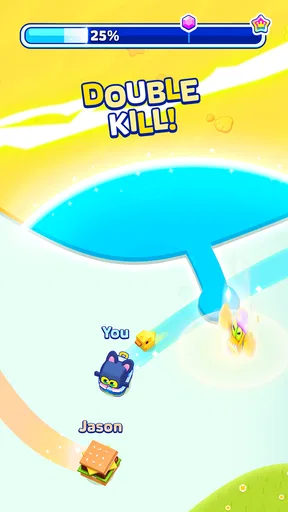
In play, you guide a colored shape away from your territory and draw a trail through open space. Returning safely closes the loop and adds the enclosed area to your patch. While you are outside your own territory, your trail is exposed; an opponent that crosses it can end the attempt. That one rule creates the tension: a small expansion is safer, while a long sweep can be rewarding but leaves more trail vulnerable.
This makes the game naturally watchable. A person waiting for their turn can follow the route and spot the danger, even without holding the device. On a family tablet, that can turn a brief session into light turn-taking: one player tries a cautious expansion, the next attempts a bolder route. There is no need to agree on a lengthy setup or remember a complicated control scheme before each go.
There is a useful difference between sharing a device and sharing progress. A pass-and-play arrangement means each person takes a turn on the same screen, but it should not be treated as a shared account or as a way to combine everyone’s results. I would keep expectations modest: let each person play for the round in front of them, and avoid assuming that a device handoff creates separate profiles or preserves distinct personal records.
For a realistic everyday use, imagine a short wait before dinner or a few spare minutes while someone else is using the television. One person can attempt a small loop, hand over the device, and let the next person decide whether to play conservatively or risk more territory. It works best when everyone is comfortable with informal turns and losing a run is accepted as part of the game rather than a reason to argue over who gets the next attempt.
Small routes are a better starting habit
My practical tip is to begin with compact loops instead of immediately chasing a dramatic takeover. A short trail takes less time to close and gives an opponent less exposed line to cross. Once you have established a little space, you can use its edge as a safer launch point and judge whether a longer route is worth the risk. This is not a guarantee of safety—other players can still interfere—but it makes your decisions easier to read.
It also gives a household a simple way to compare approaches without turning the session into a contest about who can claim the most. One player might prefer careful, repeatable loops; another might enjoy testing a large sweep. Watching those choices play out is part of the appeal, and it gives a younger or less experienced player room to learn by observation instead of receiving a long explanation.
What to establish before passing the screen
Before installing it on a shared device, I would agree on a few ordinary household boundaries: who may use the device, when play should stop, and whether the device owner needs to approve purchases. The game is free to download, but it offers in-app purchases priced from $0.84 to $49.99 per item. That range is worth discussing with children before they play, and any purchase decision should follow the device owner’s usual rules.
Do not assume that the game itself supplies household account boundaries. A turn handoff is only a social arrangement, not evidence of separate player identities, parental controls, or a family-sharing setup. If people in the home need clearly separated progress, purchase permissions, or supervised access, check the platform’s own account and device settings rather than relying on the game to manage those needs.
The same distinction matters when a device belongs to one person but is used by several. Agreeing that someone may play does not automatically mean they may change device settings or make a purchase. I find it more comfortable to settle those expectations first, especially when the screen is passed to a child. That small conversation avoids confusing an easy-to-start arcade game with a tool for managing family access.
Coordination helps more than competition
Paper.io 2 is competitive in spirit, so shared play goes more smoothly when people decide how they will take turns. A simple sequence—one attempt each, then another round if everyone still wants to play—prevents the most assertive player from holding the device indefinitely. It is also sensible to agree that a lost run ends that turn. The game’s exposed-trail risk makes sudden reversals part of the experience, and replaying immediately after every loss can stretch a brief break into a much longer session.
For younger players, I would frame the objective as experimenting with routes rather than proving who is best. That keeps attention on a useful skill: deciding how much open space to cross before returning to safety. If someone becomes frustrated by opponents interrupting a route, it may be better to pause or choose a calmer activity than to insist on another attempt. This is a quick arcade challenge, not a cooperative household task.
Coordination is also relevant when people have different levels of patience. A player who enjoys taking risks may want to make a large claim, while another may prefer steady, smaller gains. Neither style is automatically wrong, but the cautious approach is easier to recommend to a beginner because it limits exposure. If the device is being passed around, describing the route as “short and safe” or “long and risky” gives the next player a clear choice without telling them exactly how to play.
Age, trust, and what the game is—and is not
The game is rated Everyone, which makes its basic presentation suitable for a broad age range, but an age label does not settle every household question. Children may still need guidance around purchases and time spent playing, while adults may simply want to know whether the game’s brisk competitive loop fits a particular moment. I would introduce it as a light arcade game with a clear risk-and-reward rule, then let the child try a short session before deciding whether it is a good fit.
VOODOO developed the game, which has an average rating of 4.1 from around 2.5 million ratings and more than 141,000 written reviews. It has passed 100 million installs, so it is a familiar choice in the mobile arcade space. Those figures show broad reach, not that every player will enjoy its style. If someone dislikes losing progress after a risky move or prefers a cooperative game where everyone works toward the same goal, popularity will not change that mismatch.
For children who are old enough to manage a shared screen but still need clear purchase rules, I would keep the first session supervised and make the household expectations explicit. For adults sharing a device, the main practical issue is less about age and more about whether an informal, competitive game suits the group. A person who wants quiet, uninterrupted play may find spectators offering route advice distracting; someone who enjoys a little friendly commentary may find that same quality makes the game more fun.
How it compares with other arcade choices
Compared with a typical score-chasing arcade game, this one gives you a spatial goal: you are not only trying to last longer or react faster, but deciding how much territory to risk on each excursion. That makes each route feel like a small tactical choice. Against other territory-claiming games, the appeal is the directness of the loop: leave your area, draw a vulnerable trail, and return to secure ground. You can explain the central idea quickly, which is a real advantage on a shared screen.
The trade-off is that the simplicity does not necessarily make it relaxing. The exposed trail keeps attention on where opponents might cross, and a promising route can be interrupted before it closes. If you want a laid-back game that permits frequent pauses without much tension, a slower puzzle game may suit you better. If you want a shared activity based on teamwork rather than competing for map space, look for a cooperative alternative instead.
It is also a different kind of choice from an arcade game built around a long sequence of stages or a carefully planned personal campaign. Paper.io 2 is most appealing when you want a compact challenge that can be understood at a glance. Its strengths are immediate play and readable risk; its limitation is that the same basic decision—how far to venture before returning—remains the center of the experience. Players who need a deep progression system or a broad variety of activities should not choose it expecting those things.
Compatibility, cost, and current version
Paper.io 2 is free, and its current version is 4.39.0. It is available for devices running operating system version 9 or later. That gives prospective players a straightforward compatibility check: confirm the device meets that minimum before planning to install it. If it is an older shared device, checking first is especially useful because several people may be counting on it for casual play.
Although there is no purchase cost to start, optional in-app purchases mean it is not accurate to describe the experience as entirely free of spending decisions. I would treat those purchases as something to review in advance, not as a necessary part of deciding whether the core game is suitable. A parent or device owner can set expectations around purchases at the platform level and make sure every user knows that the free download does not mean every optional item is free.
The game was released on September 13, 2018, and its continued visibility is understandable: the basic loop needs little explanation, and a round can fit into a short break. Still, a long-running title is not automatically the right match for every device or household. Check the operating-system requirement, think about purchase boundaries, and consider whether the people sharing the screen actually enjoy competitive territory play.
My household verdict
I would recommend Paper.io 2 for households that want a quick, easy-to-demonstrate arcade game and are comfortable taking informal turns. Its strongest shared-device quality is how clearly a route communicates its own risk: everyone can see when a player is expanding cautiously or leaving a long trail exposed. Starting with small loops, agreeing on a turn order, and setting purchase expectations beforehand are three practical ways to make it a better fit at home.
I would skip it for a household seeking cooperative play, distinct personal spaces on one device, or a calm game that asks little attention once a round begins. The competition and possibility of a run ending suddenly are central to the experience, not minor details that a household rule can remove. If those qualities sound enjoyable, this is an approachable choice for a short shared session; if they sound irritating, a puzzle or cooperative arcade alternative is likely a better use of the same screen.
Overall, I see Paper.io 2 as a solid, focused pick rather than an all-purpose family game. VOODOO’s arcade design makes the core challenge easy to grasp, but it rewards patience and sensible risk more than reckless expansion. With a clear device-sharing routine and realistic expectations about purchases, it can make spare minutes entertaining. Without those boundaries—or for players who want teamwork and deeper variety—I would choose something else.
What we like
- Simple controls make it easy to start playing.
- Short rounds suit quick play sessions.
- Capturing territory creates a clear strategic goal.
- The colorful visuals are easy to follow.
- Offline play is available for solo matches.
What could be better
- Opponent movement can feel unpredictable.
- A single collision can erase a long run.
- The gameplay loop may become repetitive.
- Ads can interrupt the experience.
- Precise turns can be tricky on small screens.