 Analysis byWeUseApps
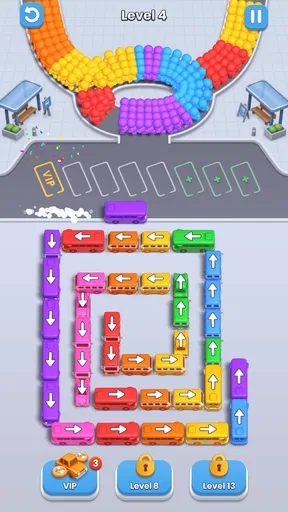
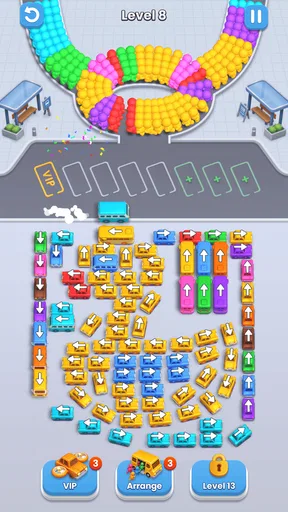
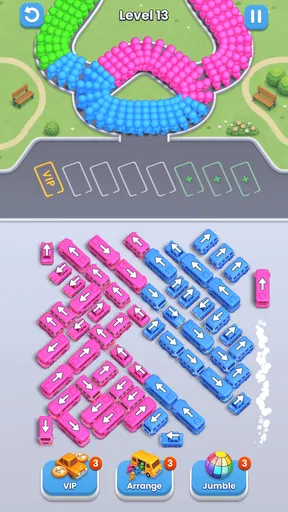
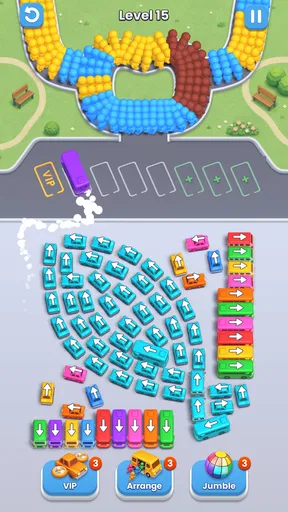
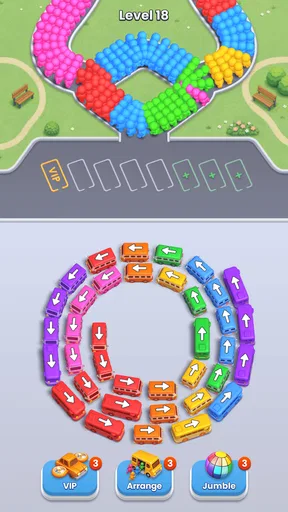
I like casual puzzle games that let me understand the challenge before asking for a long stretch of attention. Bus Fever Party! is built around a satisfying, easy-to-grasp goal: untangle a parking jam so a bus can get out. The appeal is less about racing or driving and more about looking at a crowded scene, spotting what is blocking the way, and choosing a sensible move.
That makes it a natural pick for short breaks, whether you have a few minutes between tasks or want something low-pressure to play while relaxing. I would approach it as a small logic puzzle rather than a full bus simulator. If you enjoy rearranging pieces until a route opens, the central idea should feel familiar; if you want detailed vehicle handling, a story, or a competitive driving challenge, this is probably not the game you are looking for.
What to expect from the traffic puzzle
Developed by Lumi Games, this free casual game focuses on the moment of figuring out how to clear a congested parking area. The bus gives the puzzle a clear purpose, but the thinking comes from the surrounding traffic: you need to consider which vehicles are in the way and how one move might affect the available route. The result is a compact premise that is easy to explain but can still reward patience.
The game suits players who like to scan a board before acting. Rather than tapping quickly and hoping for the best, I recommend pausing long enough to trace the bus’s path and notice which obstruction must move first. That small habit can turn a confusing-looking jam into a sequence of manageable decisions. It also makes the game a better fit for people who enjoy visual problem-solving than for players who want constant action.
It is rated for Everyone, so its basic presentation is intended for a broad audience. The game is free to download, with in-app purchases ranging from $1.99 to $99.99 per item. That range is worth noticing before you play: the core game can be tried without an upfront purchase, but optional spending may matter to people who prefer to avoid in-app purchase prompts altogether. I would check purchase controls on a shared family device before handing it to a child.
Its average rating is 4.1 from around 55,000 ratings, and it has more than 10 million installs. Those figures suggest that the simple traffic-jam concept has found a wide audience, though they are not a guarantee that every puzzle style will suit you. I would use them as context, then decide based on whether you enjoy planning moves and clearing blocked routes.
Getting started without overthinking it
For a first-time player, the best setup is simply to install the game and begin with the opening puzzle at an unhurried pace. The minimum operating-system requirement is version 8.0, and the current version is 1.2.9. Once the game is open, focus on understanding what the board is asking rather than trying to move everything immediately. The goal is to make a usable exit for the bus, so identifying that route gives every later move a purpose.
My practical first step would be to find the bus, locate the exit, and mentally draw a straight path between them. Then look for the vehicle occupying that path. If it cannot move directly, ask what space it needs and which neighboring vehicle is preventing that move. This backward-planning approach is often more reliable than picking the most visually obvious vehicle and shifting it at random.
There is also a useful distinction between a move that creates space and a move that actually advances your plan. A vehicle may be movable without helping the bus at all. Before acting, I would ask: does this clear the route, or does it make room for the vehicle that will clear the route? Thinking in those two steps helps keep a crowded board readable, especially when several cars seem to be competing for the same space.
If you are playing during a brief break, avoid rushing just because the game looks casual. A short pause to inspect the full layout can save you from making a sequence of unhelpful moves. On the other hand, if you like experimenting, trying a move and reassessing can be part of the fun. The right balance depends on whether you prefer a deliberate solve or a more relaxed trial-and-error rhythm.
The first satisfying clear
The first meaningful success is not merely moving a vehicle; it is seeing the bus’s route become open because of a deliberate chain of decisions. Start with the obstruction closest to the exit, then work backward through anything that prevents it from shifting. Once those blockers have room to move, check whether the bus can pass without another vehicle being in the way. This simple sequence gives a new player a concrete way to approach the puzzle without needing to memorize a complicated system.
A helpful trick is to distinguish between the immediate blocker and the blocker behind it. If one car must move sideways but has no free space, the next question is not “How do I move the bus?” but “What needs to move to give that car space?” In a jam, the useful move can be several steps removed from the exit. That is the kind of small planning insight that makes this format more engaging than simply tapping vehicles until something changes.
I would also avoid treating every open space as an invitation to fill it. Empty space is a resource: it may be the only place a key vehicle can move later. Before shifting a car into a gap, consider whether that move closes off another vehicle’s route or leaves you with fewer options. Keeping one or two possible follow-up moves in mind can help prevent a promising-looking rearrangement from becoming a dead end.
When the bus finally has a clear way out, the payoff comes from recognizing how the pieces fit together. That makes the game especially suited to a small pause in the day: the puzzle offers a definite objective and a clear sense of completion, without asking you to commit to a long narrative session. I would not expect it to replace a deep strategy game, but it can be a pleasant change of pace when I want a focused challenge that stays easy to pick up.
Where new players can get stuck
The most common source of confusion is looking at the whole traffic jam as one problem. It is usually easier to isolate the bus’s route and work through only the vehicles that affect it. A car on the far side of the board may be irrelevant for the moment, while a seemingly minor vehicle near the exit may be the essential first move. Filtering the layout this way reduces visual clutter and makes it clearer what to try next.
Another trap is moving a vehicle simply because it can move. A legal move is not automatically a useful move, and rearranging several cars without a plan can make the board harder to read. If you lose track of your intention, stop and reassess from the bus’s exit backward. Ask which vehicle is directly in the way, where it needs to go, and what space it requires. That reset is more helpful than continuing to make speculative moves.
Some players may also expect a bus game to emphasize driving, speed, or realistic controls. This one is better understood as a parking and traffic puzzle. That difference matters when choosing what to play: for a quick logic challenge, its focused objective is a strength; for realistic routes, vehicle upgrades, or fast reflexes, a driving game would be a better match. I would skip it if moving cars around a constrained board is not appealing even when the setting is playful.
There is a separate spending consideration. The game is free to start, but purchases are available, and the listed per-item range extends from $1.99 to $99.99. I would not assume that buying something is necessary to enjoy the central puzzle idea, nor would I make a purchase without checking what it does in the app. If you are setting it up for a child or prefer a strictly no-spend experience, use the device’s purchase controls and review any prompt before confirming it.
Who will enjoy it, and what to try next
Bus Fever Party! is a good fit for anyone who likes untangling visual problems in small, self-contained sessions. It can work well for a commute, a waiting room, or a quiet moment at home when you want to focus on one clear objective without committing to a lengthy game. It is also approachable for a first-time puzzle player because the goal is immediately understandable: find a way through the jam.
It may be less satisfying for someone who wants every session to introduce a new kind of activity. The core pleasure here is planning around blocked space, so players who tire quickly of rearrangement puzzles may find the format repetitive. Likewise, if you prefer a game that rewards quick reactions more than careful thought, a fast arcade title is likely a better choice. I see this as a useful niche game, not an all-purpose option for every mood.
Compared with many casual games that lean on matching, collecting, or rapid tapping, this one asks you to reason spatially. That changes how I would play it: I would give each board a brief visual scan, preserve useful open spaces, and move only when I can name the purpose of the move. The trade-off is that the experience depends heavily on enjoying this particular style of puzzle. Its straightforward theme helps explain the task, but the traffic-planning loop is what needs to hold your interest.
For a first session, I would aim to solve one jam thoughtfully rather than race through several. Notice which move actually unlocks the bus’s path, and use that observation on the next board. If a layout feels confusing, trace the exit backward and focus on the nearest obstruction instead of trying to reorganize the entire scene. That gives you a practical way to make progress without turning a casual game into homework.
Overall, I would recommend this to a friend who enjoys parking puzzles and wants an easy-to-start distraction with a clear goal. Lumi Games has built its appeal around one readable idea, and the best moments come from spotting a move that opens space for the next one. The free entry point makes it simple to try, while the optional purchase range is a reason to keep spending preferences in mind. If you like patient, visual problem-solving, it is worth a look; if you want a fuller driving experience or a broader mix of mechanics, choose another kind of game.
What we like
- Easy controls make it simple to steer buses through busy streets.
- Bright visuals give the city a lively look.
- Short stages suit quick play sessions.
- Unlockable buses add variety to the driving experience.
- Party-style challenges can make rounds more entertaining with friends.
What could be better
- Traffic can make some routes feel crowded.
- Repeated objectives may become familiar over time.
- Steering may take practice on tighter turns.
- Progress can feel slow when unlocking new buses.
- Performance may vary across older devices.