

 Analysis byWeUseApps
I like action games that make one simple input feel deliberate rather than frantic, and Slow Mo Strike: Knives in Time is built around that idea. You trace a path for a volley of knives, then let the action unfold in a slowed, concentrated burst. The appeal is easy to understand: planning happens in a brief pause, while the release supplies the payoff. It is a compact concept, suited to a quick play session when I want a little precision and spectacle without committing to a long campaign.
From a tracing gesture to the first strike
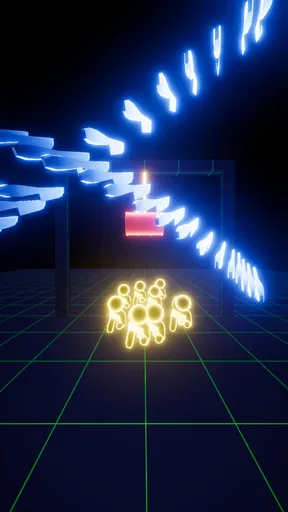
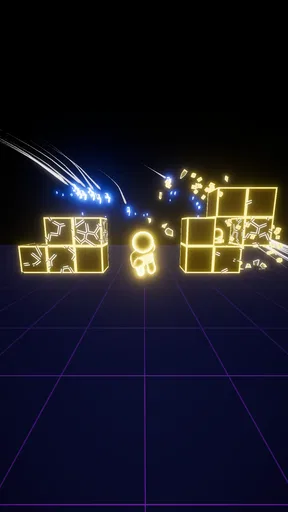
The central action is drawing a route and releasing the knives together. That changes the feel from a conventional action game, where I might repeatedly tap or react to incoming threats, to something closer to a tiny timing puzzle. I am not simply watching a slow-motion effect; the pause gives me a moment to decide how to shape the attack before the burst arrives.
The store summary describes a release involving all thirty knives, which gives the gesture a clear sense of scale. Rather than treating each knife as a separate tap, I can think about the whole movement as one planned action. That distinction matters: the fun is less about rapid button work and more about making a path that feels purposeful, then seeing whether the release matches the intention.
As an action game from KAYAC Inc., it sits on the lighter, more immediately readable end of the genre. The premise can be grasped without a tutorial-heavy explanation, which is useful when I open a game for a short break. At the same time, a simple control idea puts more pressure on the quality of the response: if tracing and release do not feel satisfying, there is little complexity to distract from that weakness.
One practical tip is to draw with a clear goal instead of making an elaborate scribble just because the game lets me trace. A deliberate route makes it easier to judge the result and understand what I would change on the next attempt. That turns a short round into a small experiment: choose a line, release, observe, and adjust.
Why the pause is part of the action
Slow motion can be more than decoration here. It gives the player a contrast between control and consequence: the trace is the controlled part, and the burst is the moment when the plan becomes visible. I find that contrast more compelling than a game that asks for constant inputs, especially when I want a focused little challenge rather than a test of reflexes alone.
It also creates a useful distinction from familiar action alternatives. A standard shooter often rewards aiming quickly and keeping pressure on a target; a typical arcade brawler puts emphasis on movement and repeated attacks. This game instead makes a single drawn action the center of attention. If you enjoy sketching a plan and watching it resolve, that difference is a strength. If you want sustained movement, a wide range of tactics, or a long sequence of escalating encounters, this is probably not the right substitute.
Feedback that gives each attempt a point
The most satisfying rhythm is the short stretch between drawing and release. I make a choice, the knives follow through, and the outcome gives me something concrete to react to. That immediate feedback is important in a game with a compact premise: each action needs to feel like it has a beginning and an end, rather than leaving me unsure whether my input mattered.
The best way to get more from that rhythm is to change one thing at a time. If a route does not look or feel right, I would simplify it on the next try rather than making a completely different gesture. Keeping the adjustment small makes it easier to tell whether the new line improved the result. It is a modest approach, but it makes repeated attempts feel intentional instead of random.
There is a trade-off, though. A one-gesture loop can feel fresh when the release is pleasing and the result is legible, but it may become repetitive for players who need frequent changes in controls or objectives. I would not recommend it as a replacement for a deeper action game. Its appeal is the clarity of a planned strike, not a broad toolkit or a sprawling set of systems.
The reward is the release, not a long checklist
What I enjoy most is the small payoff of seeing a trace turn into a coordinated burst. The pleasure comes from the transition itself: I take a moment to plan, commit to the line, and then watch the attack carry it out. That makes the game easy to pick up when I have only a little time, because I do not need to remember a complicated chain of actions before I can enjoy a round.
That same design makes expectations important. Someone looking for a deep progression track, a story-led adventure, or lots of equipment choices should look elsewhere. The game’s hook is concentrated in its core action. I would approach it as a snack-sized arcade experience, not as a game that promises a large variety of activities.
For a realistic everyday use, I can imagine opening it while waiting for a bus or taking a short break between tasks. I would make a few traces, enjoy the release, and put it away without needing a long warm-up. It also suits someone who likes tactile, gesture-based play and wants an action game that rewards a little planning. In a noisy or distracted moment, the simple premise is an advantage because it is easy to return to; for a quiet evening when I want a richer challenge, I would choose something with more layers.
When another session begins
The loop invites another attempt because the next trace offers a fresh chance to shape the burst. The reset is part of the appeal: I do not have to carry a long strategy across a lengthy run, and a disappointing attempt can be followed by a quick change in approach. I can try a straighter line, a more considered curve, or simply make the next gesture cleaner.
That repeatability is also the main risk. If the satisfaction of the release does not hold your attention, the reset may feel like repetition rather than an invitation. Players who prefer unlocking new abilities, learning complex enemy patterns, or building a strategy over many stages may find the core loop too narrow. I would give it a try if the act of planning a single attack sounds fun in itself, not because I expect a full-scale action campaign.
For anyone wondering whether it is easy to start, the controls described by the premise are straightforward: trace and release. The interesting part is developing a feel for the gesture, not memorizing a long command set. I would begin with simple paths and only add complexity when the basic release feels clear. That is a more useful way to judge whether the game clicks than trying to force a perfect-looking trace immediately.
Who will enjoy this focused action game
Slow Mo Strike is free to play, carries a Teen content rating, and is listed for devices running Android 5.1 or later. Its audience reach is substantial, with over five million installs, while its average rating stands at 4.7 from around eleven thousand ratings. Those figures suggest that many players have responded well to the concept, but the more useful question is whether you like this kind of focused, gesture-led action.
The game is a good fit for players who enjoy quick experiments, clean cause-and-effect, and a visible payoff for a deliberate input. It is less suitable for anyone who wants a lengthy story, complex controls, or a wide range of modes. The current version is 017, and the game was released on May 14, 2026; I would treat those details as useful context when checking compatibility and deciding whether to try it, rather than as a promise about how much content is inside.
A satisfying burst, with a deliberately narrow scope
My verdict is that Slow Mo Strike: Knives in Time works best when I judge it by its small, repeatable loop. The trace gives me a moment to think, the release provides the immediate reward, and the quick reset makes another attempt feel accessible. It does not need to be a sprawling game to make that exchange enjoyable, but its narrow focus will not suit every action fan.
I would recommend it to a friend who wants a free, easy-to-understand game for brief breaks and likes seeing a planned gesture turn into a burst of action. I would steer a friend seeking long-term tactical depth toward a broader action title instead. For the right mood, this one has a clear reason to play: make a line, commit to it, enjoy the result, and see whether the next trace can feel even better.
What we like
- Simple controls make it easy to start playing.
- Slow-motion effects add dramatic flair to each throw.
- Short rounds suit quick gaming sessions.
- Precise timing gives players a clear skill challenge.
- The knife-throwing theme stands out from typical casual games.
What could be better
- Repeated throws can make the gameplay feel predictable.
- Timing challenges may frustrate players seeking a relaxed game.
- Progress can feel limited without varied objectives.
- Frequent retries may interrupt the pace of play.
- The slow-motion effects may lose their novelty over time.